


realtystarnetwork.netBuying & Owning · South MississippiThe House Is the DifferenceTwo families pay about the same thing every month for a place to live. Thirty years later, one owns a
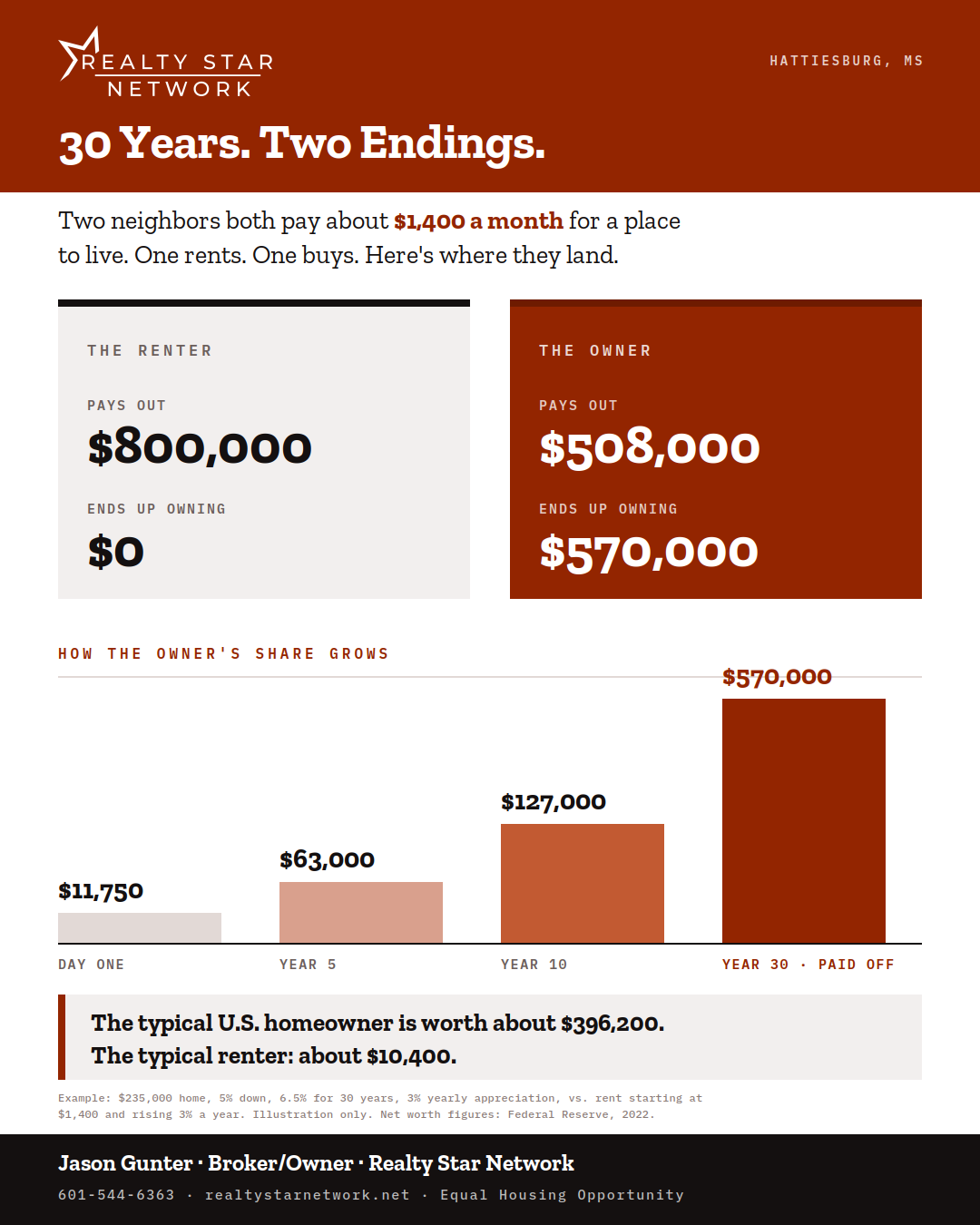
Picture two families on the same street in Hattiesburg. Both write a check for about $1,400 every month for a place to live. One check goes to a landlord. The other goes to a mortgage company.
For the first few years, it's hard to tell them apart. Same street. Same size house. Same money going out the door.
But thirty years later, they are not in the same place at all. One family owns a house worth over half a million dollars and pays no house payment. The other family is still writing a rent check — a much bigger one than they used to.
That gap is the biggest reason some families pass money down to their kids and other families start over from zero every generation. Here's how it happens.
REASON 1A house payment is savings you can't skip
Most of us mean to save money. Then the truck needs tires, or Christmas comes, and the saving doesn't happen. It's not a character flaw. It's just how life goes.
A house payment fixes that problem in a sneaky way: you can't skip it. Every single month, part of that payment goes into your own pocket whether you were planning to save or not.
Here's a real example at Hattiesburg-area prices. A $235,000 house, $11,750 down, at 6.5% for 30 years. The house payment is about $1,411 a month.
What You Own, Year by Year $235,000 house · $11,750 down · 6.5%
| At year | House is worth | You still owe | You own |
|---|---|---|---|
| Day one | $235,000 | $223,250 | $11,750 |
| Year 5 | $272,000 | $209,000 | $63,000 |
| Year 10 | $316,000 | $189,000 | $127,000 |
| Year 30 | $570,000 | Nothing | $570,000 |
Assumes the house gains 3% a year in value. Taxes, insurance, and repairs are on top of the payment. Example only.
Now, I'll be straight with you about the ugly part. In that very first month, only $202 of your $1,411 goes toward the house. The other $1,209 is interest — money you pay the bank for the loan. Over the full 30 years, you'll pay roughly $285,000 in interest.
That's real money and nobody should hide it from you. But look at the chart again. Even after paying all that interest, the family still ends up with a $570,000 house. The renter paid about $800,000 and ends up with nothing.
The other thing worth knowing: it gets better every year. That $202 grows every single month. By year ten, more than half your payment is going toward the house instead of the bank.
REASON 2The whole house goes up in value — not just your part
This is the part almost nobody explains, and it's the biggest one.
That family put down $11,750. If the house goes up 3% in a year, they don't make 3% on their $11,750. They make 3% on the whole $235,000 house. That's about $7,050 in one year — on an $11,750 investment.
Think about what that means. The bank put up most of the money, but the family keeps all of the gain. There is no other deal like this available to regular people. A bank will hand a first-time buyer $220,000 to buy a house. No bank is going to hand you $220,000 to buy stocks.
Fair warning, though: this works in reverse too. If home values drop and you have to sell right away, you can lose money fast for the same reason. That's why the honest advice is always the same — buy when you plan to stay a while.
Rent goes up forever. A house payment is the last time your housing cost ever goes up on purpose.
REASON 3Your payment stops going up. Rent never does.
Rent today is $1,400. If it goes up just 3% a year — which is modest — that same renter is paying more than $3,300 a month by year thirty. Over the whole stretch, they'll hand a landlord around $800,000.
The homeowner's loan payment is $1,411 in year one. And it's $1,411 in year thirty. Same number.
I won't pretend the whole bill is frozen. Property taxes go up, and here in South Mississippi, insurance has gone up a lot. Those parts move. But the biggest piece — the loan itself — is locked in for good. Every raise you get makes that payment feel smaller.
And then there's the year the loan is paid off. Suddenly a family that was paying $1,800 a month is paying maybe $400 for taxes and insurance. That's a $1,400-a-month raise they keep for the rest of their lives. For a lot of folks, that one change is what makes retirement work at all.
REASON 4The house is still there after you're gone
This is where it turns into something you can hand down.
A lease ends when you do. A house doesn't. When you pass away, the house goes to your family.
And there's a tax rule that helps them out. If your kids sell the house shortly after inheriting it, they generally don't get taxed on all those years the house went up in value. Thirty years of growth can pass to them without a big tax bill. That is one of the best deals left in the tax code, and it works the same on a house in Petal as it does on a house in California.
What your kids do with it changes their whole life. They can move in and have no house payment. They can sell it and finally have a down payment of their own. They can rent it out and have income every month. Any one of those moves a family forward a full generation.
THE BIG ONEThe mistake that can wipe all of it out
I've been doing this in South Mississippi for over 25 years, and I need to spend a minute here — because this is where I've watched families lose everything they built.
If you die without a will, your house does not go to one person. It goes to all of your legal heirs at the same time. Every child gets a piece. Then when they pass, their children each get a piece of a piece.
Give it twenty years and one family home can be owned by fifteen or twenty cousins, half of whom you haven't seen since a funeral. Lawyers call that heirs' property, and it is a serious problem all over the South, including right here.
Here's what goes wrong with it:
When nobody owns it clearly
- Nobody can sell it. You need every single cousin to sign. One holdout, and it's stuck.
- Nobody can borrow against it. No bank will lend on a house when no one can prove they own it.
- No storm help. After a hurricane, FEMA and repair programs want proof of ownership. Heirs' property owners often can't provide it.
- The taxes go unpaid. Everybody figures another cousin took care of it. Nobody did. The county sells the property for back taxes.
- One cousin can force a sale. Any single heir can go to court and make the whole property sell — often for far less than it's worth. Investors buy one cousin's small share on purpose just to do this.
Mississippi has passed a law that helps some. It requires a real appraisal, gives the other family members a chance to buy out whoever filed, and pushes courts to split the land instead of selling it. That's real protection. But it's a seatbelt, not a fix.
The actual fix is cheap and boring. Get a will. If your name isn't on the deed, get that corrected now. If you inherited property, go find out whose name is actually on it before you need to know. An afternoon with a Mississippi attorney protects something that took thirty years of house payments to build.
I've watched families do everything right for two generations and lose the place over paperwork. Don't let that be yours.
When buying is NOT the right move
I'd rather tell you this now than let you find out the expensive way.
- You might move in the next 3 to 5 years. It costs real money to buy and sell. A short stay usually loses. Rent and stay flexible.
- The payment would be tight. A house you can barely afford isn't an asset — it's a trap. Roofs and AC units don't care what your budget is. Plan on about 1% of the home's value each year for repairs.
- You'd have to spend every dollar you have. Buying with nothing left over is how people end up putting a $9,000 AC unit on a credit card.
- Your job or family situation isn't settled. That's not a failure. That's a good reason to wait a year and buy from a stronger spot.
Renting is the smart call sometimes. Just know it isn't building anything — so if you're renting, you need another plan running alongside it.
WHERE TO STARTFour things you can do this month
1. Find out where you actually stand. Talk to a local lender before you look at a single house. Most people who think they can't buy have never asked. Ask specifically about down payment help through the Mississippi Home Corporation, and about USDA loans — a lot of land in Forrest, Lamar, and Perry County qualifies for zero down, and most buyers here have no idea.
2. Get your real numbers, not average ones. What matters is the payment on one specific house, with a real insurance quote. Insurance around here can swing a payment by hundreds of dollars. Know that number before you fall in love with a house, not at closing.
3. Buy a payment you can handle in a bad year. All the money in that chart comes from staying put for thirty years. Anything that helps you stay is worth more than a bigger house.
4. Protect it the day you close. Will. Deed in the right name. Beneficiaries listed. Insurance you've actually read. This is the step that decides whether it's still in your family in 2060.
Nobody in those numbers got lucky. They just made a payment that happened to build something, stayed put long enough for it to add up, and left the paperwork clean for the next generation.
 MLS United® - All information deemed reliable but not guaranteed. All properties are subject to prior sale, change, or withdrawal. Neither listing broker(s) or information provider(s) shall be responsible for any typographical errors, misinformation, misprints and shall be held totally harmless. Listing(s) information is provided for consumer's personal, non-commercial use and may not be used for any purpose other than to identify prospective properties consumers may be interested in purchasing.
 Hattiesburg Area Association of REALTORS® All information deemed reliable but not guaranteed. All properties are subject to prior sale, change or withdrawal. Neither listing broker(s) or information provider(s) shall be responsible for any typographical errors, misinformation, misprints and shall be held totally harmless. Listing(s) information is provided for consumer's personal, non-commercial use and may not be used for any purpose other than to identify prospective properties consumers may be interested in purchasing. The data relating to real estate for sale on this website comes in part from the Internet Data Exchange program of the Multiple Listing Service. Real estate listings held by brokerage firms other than Realty Star Network may be marked with the Internet Data Exchange logo and detailed information about those properties will include the name of the listing broker(s) when required by the MLS. Copyright ©2026 All rights reserved.
Last Updated: September 27, 2026 12:40 PM UTC
Hattiesburg Area Association of REALTORS® All information deemed reliable but not guaranteed. All properties are subject to prior sale, change or withdrawal. Neither listing broker(s) or information provider(s) shall be responsible for any typographical errors, misinformation, misprints and shall be held totally harmless. Listing(s) information is provided for consumer's personal, non-commercial use and may not be used for any purpose other than to identify prospective properties consumers may be interested in purchasing. The data relating to real estate for sale on this website comes in part from the Internet Data Exchange program of the Multiple Listing Service. Real estate listings held by brokerage firms other than Realty Star Network may be marked with the Internet Data Exchange logo and detailed information about those properties will include the name of the listing broker(s) when required by the MLS. Copyright ©2026 All rights reserved.
Last Updated: September 27, 2026 12:40 PM UTC
 All information deemed reliable but not guaranteed. All properties are subject to prior sale, change or withdrawal. Neither listing broker(s) or information provider(s) shall be responsible for any typographical errors, misinformation, misprints and shall be held totally harmless. Listing(s) information is provided for consumer's personal, non-commercial use and may not be used for any purpose other than to identify prospective properties consumers may be interested in purchasing. The data relating
